



Structure
The Department’s undergraduate study program covers the full spectrum of Economic Science and its applications, offering students both a solid foundation in economics and the opportunity to specialize in important areas of the field.
Degree Requirements
Overall, successful completion of the Study Program requires passing thirty-six (36) courses (with the degree grade determined by the average grade of these courses), in addition to four (4) courses (I–IV) in the same foreign language, as well as the accumulation of two hundred and forty (240) ECTS credits.
Each course in the Study Program corresponds to six (6) ECTS credits. Specifically, two hundred and sixteen (216) ECTS credits correspond to the thirty-six (36) courses in the Study Program (36 × 6 ECTS), and twenty-four (24) ECTS credits correspond to the four (4) foreign language courses (4 × 6 ECTS).
STRUCTURE OF THE STUDY PROGRAM
• 19 Core Courses (COMPULSORY)
• 8 Compulsory Specialization Courses from one of the three available specializations selected by students:
- Economic Theory and Policy
- Business Economics and Finance
- International and European Economics
To declare their specialization, students must have successfully passed 16 courses, of which 12 must be Core Courses, while the remaining may come from any category (core, specialization, or elective).
The above courses do not include Teaching and Pedagogical Competency courses, Foreign Language courses, or Internship.
Students who have successfully passed twenty-six (26) out of the thirty-six (36) courses are eligible to apply for a change of specialization.
• 9 Elective Courses chosen from:
a. Elective courses offered by the Department of Economics and/or
b. Remaining courses from the selected specialization beyond the eight (8) compulsory specialization courses, and/or
c. Courses from any other specialization, and/or
d. Up to three (3) courses (free electives) offered by other Departments (from the course lists announced during the Fall and Spring semesters of each academic year).
• 4 Courses (I, II, III, IV) in one foreign language (English, French, German)
These courses are graded only as “Pass” or “Fail” and do not receive numerical grades.
Students are exempt from Foreign Language Courses I & II upon proof of Good/Very Good knowledge of a foreign language. They are exempt from Courses I, II, III, and IV upon proof of Excellent knowledge of a foreign language, by submitting a certified copy of a recognized language certificate included in the ASEP list of accepted language qualifications.
♦ FOREIGN LANGUAGE TRANSITIONAL RULES
• Internship
The Internship course is optional and is not taken into account for degree requirements.
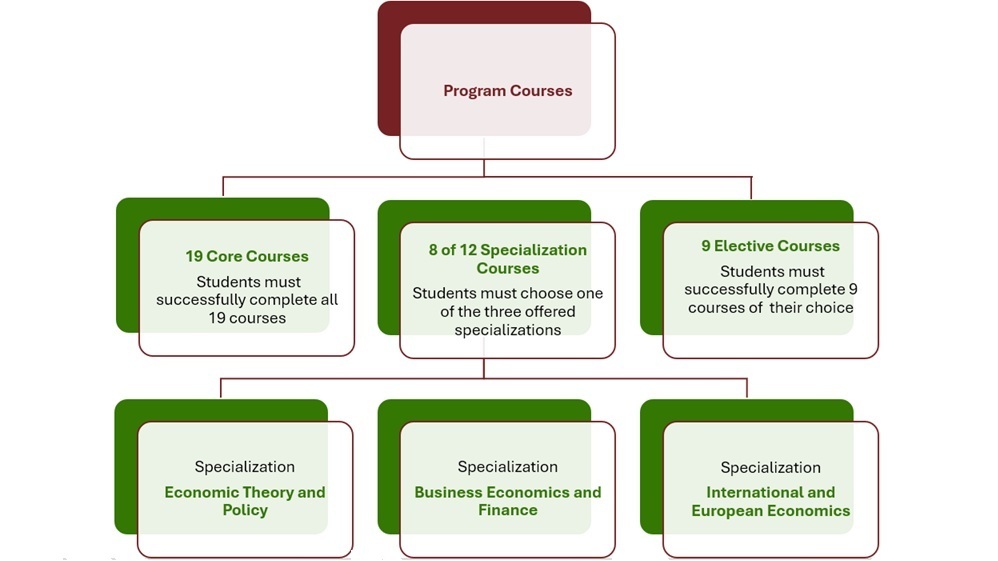
IN DETAIL:
The undergraduate program includes nineteen (19) core courses (compulsory):
- Introduction to Economic Analysis I
- Introduction to Economic Analysis II
- Statistics I
- Statistics II
- Mathematics for Economists I
- Mathematics for Economists II
- General Economic History
- Principles of Financial Accounting
- Microeconomic Theory I
- Microeconomic Theory II
- Macroeconomic Theory I
- Macroeconomic Theory II
- Introduction to Econometrics (for students admitted from 2012-13 onwards)
- International Economics
- Money and Banking
- Industrial Organization
- Econometrics I
- History of Economic Thought
- Public Economics I
Specialization courses
Upon choosing a Specialization, students must select at least eight (8) courses from their Specialization course list, which will be considered as Compulsory Track Courses. Any remaining courses selected from the same specialization, or courses from other specializations, can count towards the 9 elective courses required.
ECONOMIC THEORY AND POLICY SPECIALIZATION
- Development Economics
- Methodology of Economics
- Labour Economics
- Econometrics II
- Public Economics II
- Theory of Industrial Organization
- Games Theory and Uncertainty
- Topics in Dynamic Economics
- Theory of Economic Policy
- Monetary Theory and Policy
- International Monetary Relations
- Theory of Economic Growth
- Theory and Policy of International Trade
BUSINESS ECONOMICS AND FINANCE SPECIALIZATION
- Business Economics
- Investment Appraisal
- Computer Applications
- Corporate Finance
- Analysis of Capital and Money Markets
- Banking Theory and Practice
- Topics in Financial Economics
- Advanced Financial Accounting
- Applied Industrial Organization
- Environmental and Natural Resource Economics
- Labour Economics
- Agricultural Economics
- Financial Derivatives Analysis
INTERNATIONAL AND EUROPEAN ECONOMICS SPECIALIZATION
- Development Economics
- Economic Geography
- Agricultural Economics
- Theory of Economic Policy
- Monetary Theory and Policy
- International Monetary Relations
- Environmental and Natural Resource Economics
- Political Economy of the EU
- Theory of Economic Growth
- Theory and Policy of International Trade
- Regional and Urban Economics
ELECTIVE COURSES - DEPARTMENT OF ECONOMICS
- Economic Law
- Introduction to Political Science and International Relations
- Introduction to Computers
- Economic History of Greece
- Marxian Economics I
- Marxian Economics II
- Mathematics for Economists III
- Entrepreneurship
- Law and Economics
- Structure and Problems of the Greek Economy
- Time Series and Forecasts
FREE ELECTIVE COURSES FROM OTHER DEPARTMENTS (UP TO 3)
 Patision 76
 2108203 303